
Close Menu
  • Home
  • Maritime
  • Offshore
  • Port
  • Oil & Gas
  • Energy
  • Technology
  • Incidents
  • Environment
  • Events
    • Maritime
    • Offshore
    • Oil & Gas
    • Energy
  • Advertising
  • Contact
Facebook X (Twitter) Instagram LinkedIn
Trending
  • European refiners could drive green hydrogen momentum, with maritime sector playing important role
  • North Sea yields ‘significant’ black gold discovery
  • Falmouth Scientific, Inc. Receives ISO 9001:2015 Quality Certification
  • New leadership for Oceanbird – Splash247
  • Boats Group lawsuit alleges monopoly in US listings
  • Hollandse Kust West Beta cable tests completed
  • New Fred. Olsen 1848 floating solar lead brings experience from SolarDuck, Equinor
  • Strohm’s TCP jumpers make their way to Malaysian deepwater sector
Facebook X (Twitter) Instagram LinkedIn
Maritime247.comMaritime247.com
  • Home
  • Maritime
  • Offshore
  • Port
  • Oil & Gas
  • Energy
  • Tech
  • Incidents
  • Environment
  • Events
    • Maritime
    • Oil & Gas
    • Offshore
    • Energy
  • Advertising
Maritime247.comMaritime247.com
Home»Technology»Ocean Robots Explore the Role of ‘Marine Snow’ in Carbon Storage
Technology

Ocean Robots Explore the Role of ‘Marine Snow’ in Carbon Storage

May 29, 2025
Facebook Twitter LinkedIn WhatsApp Reddit Tumblr Email
Share
Facebook Twitter LinkedIn Email

Exploring the Depths of the Labrador Sea with Ocean Robots

A fleet of ocean robots and instruments has embarked on a groundbreaking exploration of the Labrador Sea, led by scientists from the UK’s National Oceanography Centre (NOC). The ReBELS project (Resolving Biological Carbon Export in the Labrador Sea) aims to unravel the mysteries of the biological carbon pump, a crucial ocean process that helps mitigate climate change by removing carbon dioxide from the atmosphere.

Unveiling the Biological Carbon Pump

The biological carbon pump is a key player in regulating Earth’s climate. Microscopic marine plants, known as phytoplankton, absorb carbon dioxide from the atmosphere and convert it into organic material. This material is then consumed by marine organisms, with remnants sinking as ‘marine snow’—carbon-rich particles that settle in the deep ocean, where carbon can be stored for centuries.

Dr. Filipa Carvalho, the project lead at NOC, emphasizes the vital role of the biological carbon pump in maintaining Earth’s climate balance.

Innovative Technology at Work

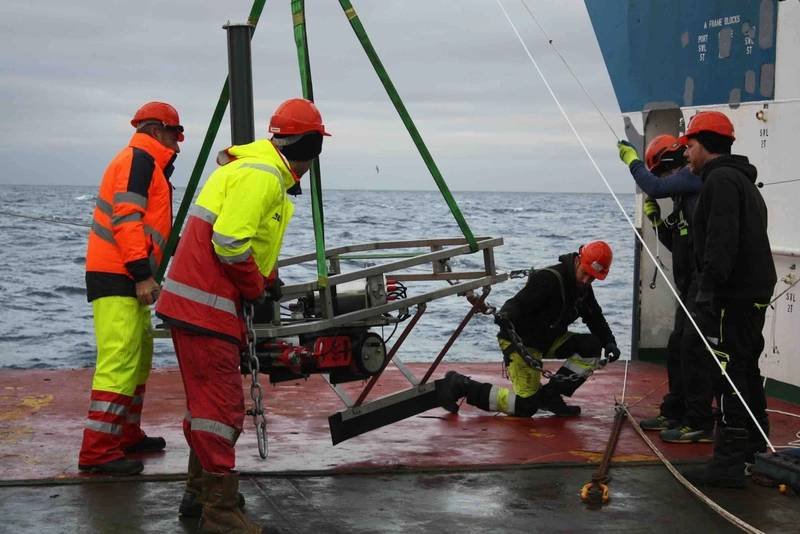
The ReBELS project utilizes a variety of cutting-edge technologies, including moored sensors, drifting profiling floats, autonomous underwater vehicles, and the innovative FluxCAM—a marine snow camera system designed to measure the sinking speeds of different-sized particles and reduce uncertainties in carbon absorption by the ocean.

Two FluxCAMs were deployed on a deep-sea mooring in the Labrador Sea, accompanied by specially programmed drifting profiling floats. Autonomous underwater gliders have now joined the mission, collecting data on ocean properties and carbon flux for an extended period.

Overcoming Challenges

One of the main challenges in studying carbon flux is understanding the rate at which sinking particles transport and transform carbon. The combination of fixed moored sensors, drifting instruments, and mobile gliders in the ReBELS project offers a comprehensive approach to tracking carbon movement in the Labrador Sea.

See also  Leidos Unveils Sea Dart UUV

Dr. Louis Clement, co-investigator at NOC, highlights the significance of this multi-faceted approach in unraveling the complexities of the biological carbon pump.

Future Insights and Implications

Supported by funding from the Natural Environment Research Council (NERC), the ReBELS project is a four-year endeavor that builds upon decades of research into ocean carbon storage. By leveraging state-of-the-art robotic technology, the project aims to provide new insights into one of the ocean’s critical climate-regulating mechanisms.

Ultimately, the findings from the ReBELS project are expected to enhance our understanding of global climate change dynamics and improve our ability to predict and respond to environmental challenges.

carbon explore Marine Ocean Robots Role Snow Storage
Share. Facebook Twitter LinkedIn Tumblr Telegram Email

Related Posts

European refiners could drive green hydrogen momentum, with maritime sector playing important role

August 21, 2025

Falmouth Scientific, Inc. Receives ISO 9001:2015 Quality Certification

August 21, 2025

Antarctica Undergoing Abrupt Change

August 21, 2025
Top Posts

Top 16 Biggest LNG Ships

April 16, 2025

Duties of Bosun (Boatswain) on a Ship

February 1, 2025

Sea-Doo Switch recall underway after serious safety concerns

March 2, 2025

10 Largest Naval Guns Ever Mounted On Warships

December 31, 2024
Don't Miss
Offshore

LS Marine Solution invests €221 million in new high-spec cable laying vessel

June 5, 2025

LS Marine Solution Invests in New Cable Laying Vessel to Expand Operations South Korean subsea…

Obituary: Karl Kenny, Founder, Kraken Robotics

February 15, 2025

ZEUS on the move: Wheels up to turn stranded gas reserves into sustainable energy sources

August 16, 2025

Three Migrants Die as Boat Capsizes Between France and UK

December 31, 2024

Subscribe to Updates

Your Weekly Dive into Maritime & Energy News.

About Us
About Us

Stay informed with the latest in maritime, offshore, oil & gas, and energy industries. Explore news, trends, and insights shaping the global energy landscape.

For advertising inquiries, contact us at
info@maritime247.com.

Facebook X (Twitter) YouTube LinkedIn
Our Picks

French containment tech selected for Purus’ new LNG carrier

June 18, 2025

Equinor: Statement on Halting Empire Wind Project

April 17, 2025

Stolt-Nielsen enters LNG bunkering after Avenir LNG takeover

January 29, 2025

Subscribe to Updates

Your Weekly Dive into Maritime & Energy News.

© 2025 maritime247.com - All rights reserved.
  • Contact
  • Privacy Policy
  • Terms & Conditions
  • Advertising

Type above and press Enter to search. Press Esc to cancel.